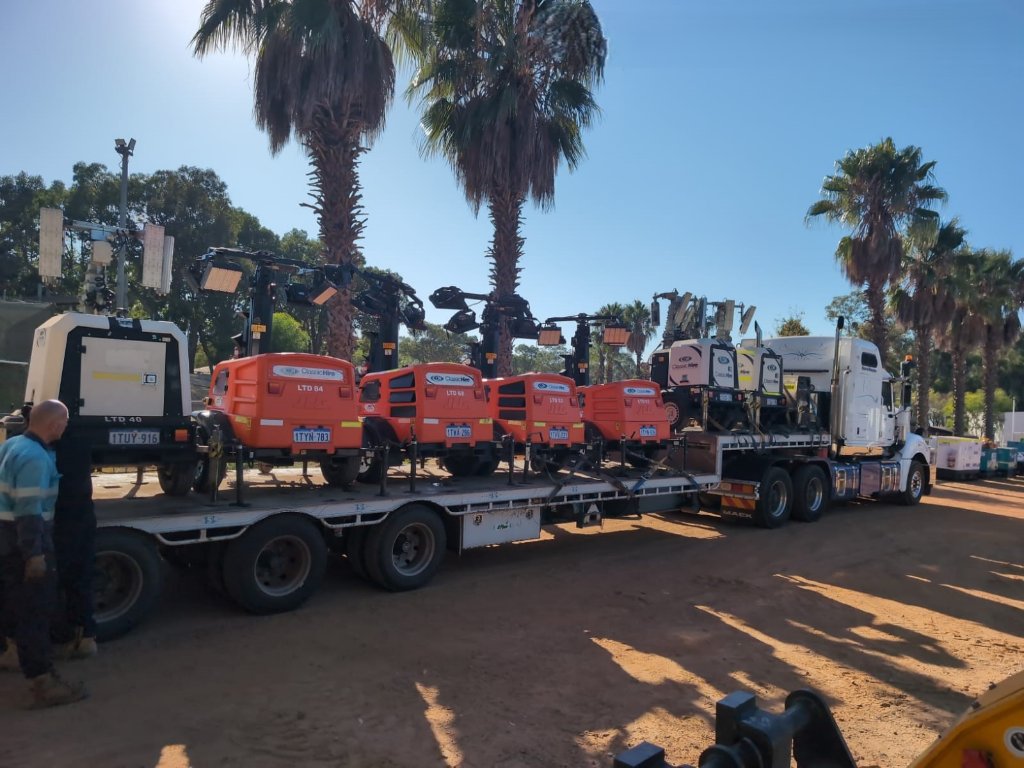
What Is Heavy Haulage?
Heavy haulage — also called oversize or over-mass transport — is the movement of loads that exceed standard legal dimension or weight limits on Western Australian roads. Any vehicle or load combination that exceeds the prescribed limits is classified as a Restricted Access Vehicle (RAV) and must operate under a permit or order issued by Main Roads Western Australia.
Heavy haulage is common across WA's resources, construction, agriculture, and infrastructure sectors. Mining equipment, processing vessels, wind turbine components, agricultural machinery, prefabricated buildings, and large industrial plant are all regularly moved under oversize permits across the state.
WA Oversize and Over-Mass Limits
According to Main Roads Western Australia, a vehicle or vehicle combination is classified as a Restricted Access Vehicle (RAV) — and therefore requires a permit or order — if it exceeds any of the following limits:
- Width: 2.5 metres
- Height: 4.3 metres from ground level
- Length: 12.5 metres for a rigid vehicle, or 19 metres for a combination
- Gross mass: 42.5 tonnes
- Single axle: 9 tonnes
- Single steer axle: 6 tonnes
- Twin steer axle group (non-load sharing suspension): 10 tonnes
- Twin steer axle group (load sharing suspension): 11 tonnes
- Tandem axle group: 16.5 tonnes
- Tri or quad axle group: 20 tonnes
Permits are issued by Main Roads Western Australia and set out specific conditions, including approved routes, travel windows (often daylight only, or excluding peak hours in urban areas), and escort requirements.
Source: Main Roads WA — Permits, Orders and Schemes
Types of Permits in Western Australia
Main Roads Western Australia issues several categories of permits and orders depending on the dimensions, mass, and type of load:
- OSOM Single Trip Permits — for a specific oversize/overmass load on a specific route and date
- OSOM Class 1 RAV Period Permits — for operators who regularly move loads within defined parameters
- OSOM Assorted Period Permits — for recurring oversize movements under defined conditions
- Special Purpose Vehicle permits — for vehicles built for specific functions (e.g. cranes, concrete pumps)
- Orders — for loads that exceed standard permit conditions and require Main Roads assessment
- Accredited Mass Management Scheme (AMMS) — for accredited operators managing mass compliance
- Harvest Mass Management Scheme (HMMS) — for agricultural freight during harvest periods
- Oversize Road Trains and B Doubles — for extended road train configurations
- Heavy Lift Tow Truck — for heavy vehicle recovery and towing
- Block Truck — for specific oversized load movements
The permit application process requires detailed information about the vehicle configuration, load dimensions, proposed route, and travel windows. Applications are lodged through the MOVES online portal. Experienced heavy haulage operators handle this on behalf of their clients as part of the transport arrangement.
Source: Main Roads WA — Permit Categories
Pilot Vehicles and Traffic Escort Wardens
Oversize loads in WA are accompanied by trained professionals who manage traffic and ensure safe passage. There are two key roles, each with different thresholds and responsibilities.
Heavy Vehicle Pilots
Heavy Vehicle Pilots travel with oversize vehicles and provide advance warning to other road users. The number and positioning of pilots depends on the size of the load and the requirements to manage traffic safely.
Pilot vehicles are identified by:
- A large yellow reflective sign reading "Oversize Load Ahead"
- Amber flashing warning lights mounted on the roof
- For loads exceeding 4.5 metres in width: additional white flashing lights on the front of the lead vehicle
Pilots communicate with traffic using signs, flashing lights, hand signals, and verbal instructions on UHF channel 40. Drivers are legally required to follow any directions given by pilots.
Traffic Escort Wardens (TEWs)
Traffic Escort Wardens accompany high-risk oversize and overmass (OSOM) vehicles. A Traffic Escort Warden is required when the dimensions of the OSOM vehicle and its load exceed:
- 5.5 metres in width, and/or
- 40 metres in length
Traffic Escort Vehicles are identified by red and blue flashing lights on the roof and "Traffic Escort" displayed on both sides of the vehicle. Their responsibilities include:
- Preparing a journey management plan
- Submitting a Green Light Corridor request if required (allowing traffic signals to be remotely managed for safe passage through metropolitan areas)
- Conducting pre-movement safety and compliance checks in line with permit requirements
- Controlling and directing traffic throughout the movement
- Completing daily reports, vehicle logs, and administrative paperwork
Police escorts may also be required for very large loads passing through urban areas or high-traffic corridors.
Source: Main Roads WA — Be Oversize Wise
Powerline Clearance and Utility Authorisations
Oversize loads that are 4.3 metres or taller may come into contact with overhead powerlines. In Western Australia, utility authorisation is required in addition to Main Roads permits:
- Western Power covers the South West Interconnected System (SWIS), which includes Perth metro and the South West. Western Power deems all loads 4.3 metres and over as oversize and requires an authorisation request for assessment. An Oversize Load Movement Authorisation is then issued setting out any special conditions.
- Horizon Power covers regional and remote WA outside the SWIS. Separate authorisation is required for loads travelling in Horizon Power's network area.
- For inter-district travel between Western Power and Horizon Power networks, a single application can be lodged with the network at the point of origin.
In some cases, substantial planning or construction works are required — such as undergrounding, moving, or raising powerlines. Line height reports are available for both metro and country areas to help operators plan routes that comply with clearance restrictions.
Source: Western Power — Oversize Loads
Route Planning for Oversize Loads
Not every road in WA can accommodate an oversize load. Route planning is a critical part of the process and involves:
- Identifying overhead clearances (power lines, bridges, gantries) using line height reports and the Main Roads RAV Network Map
- Assessing road surface condition and load-bearing capacity
- Identifying pinch points, tight corners, and narrow sections
- Coordinating with utilities and local authorities where overhead infrastructure needs to be temporarily moved
- Planning fuel stops and rest areas for multi-day movements
- Checking the RAV Network Map to confirm approved routes for the vehicle configuration
In remote WA, this process can be particularly complex. Roads to mine sites and remote pastoral areas may be unsealed, require creek crossings, or have restricted access conditions during wet season periods.
Main Roads WA provides several tools to assist with route planning:
- RAV Network Map — shows approved routes for different RAV classes
- HVAT (RAV Rating Tool) — assesses vehicle configurations against route requirements
- MOVES — Main Roads' online portal for permit applications and management
- Traffic Guidance Scheme (TGS) — for managing traffic during complex movements
- Bridge Video Supervision (BVS) — for monitoring load passage over bridges
Vehicles Used in WA Heavy Haulage
Heavy haulage requires specialist vehicles matched to the load. Common configurations include:
- Low loaders — for tall machinery that needs to sit as low as possible for height clearance
- Extendable trailers — for long loads such as vessel sections or wind turbine blades
- Modular trailers (SPMTs) — self-propelled modular transporters for very heavy or complex loads
- Tilt trays and beaver tails — for loading and unloading wheeled or tracked plant
- Crane trucks and Hiabs — for loads requiring lifting at the point of delivery
What Does an Oversize Transport Job Involve?
Heavy haulage in WA involves multiple coordinated steps. A typical oversize movement includes:
- Assessing load dimensions and mass against RAV limits
- Determining the required permit category and applying through Main Roads WA (MOVES portal)
- Planning and surveying the route, including overhead clearance checks
- Obtaining utility authorisations (Western Power or Horizon Power) for loads 4.3 metres and over
- Engaging the required number of Heavy Vehicle Pilots based on load width
- Engaging Traffic Escort Wardens for loads exceeding 5.5 metres wide or 40 metres long
- Coordinating travel windows (often daylight only, excluding peak hours)
- Conducting pre-movement safety and compliance checks
- Executing the movement with real-time traffic management
The best approach is to provide your transport provider with as much information as possible — load drawings, dimensions, photographs, origin and destination details — so they can manage the entire process on your behalf.
PTWA's Oversize Transport Services in WA
PTWA operates oversize and over-mass transport across Western Australia, with experience across the Pilbara, Kimberley, Goldfields, Mid West, South West, and Perth metro regions. We manage the full process from permit application and route planning through to pilot escort and on-site delivery.
To discuss an oversize transport requirement, call us on 1300 007 892, available 24/7, or email sales@ptwa.com.au with your load details.
Frequently Asked Questions
When do I need a permit for oversize transport in WA?
You need a permit from Main Roads Western Australia when your vehicle or load exceeds any of the standard RAV limits: 2.5 metres in width, 4.3 metres in height, 12.5 metres length (rigid vehicle) or 19 metres length (combination), 42.5 tonnes gross mass, or the prescribed axle group limits.
When is a Traffic Escort Warden required in WA?
A Traffic Escort Warden is required when the oversize vehicle and its load exceed 5.5 metres in width and/or 40 metres in length. These are classified as high-risk OSOM movements.
When is a pilot vehicle required in WA?
Heavy Vehicle Pilots are required for oversize loads that exceed standard dimension limits. The number and positioning of pilots depends on the load dimensions and road type. For loads exceeding 4.5 metres in width, the lead pilot vehicle displays additional white flashing lights on the front.
Who issues oversize permits in Western Australia?
Main Roads Western Australia issues all oversize and over-mass permits and orders. Applications are lodged through the MOVES online portal. For loads 4.3 metres and over in height, separate authorisation is also required from Western Power (SWIS network) or Horizon Power (regional WA).
Do I need Western Power authorisation for oversize loads?
Yes. Western Power deems all loads 4.3 metres and over as oversize and requires an authorisation request. An Oversize Load Movement Authorisation is issued setting out any special conditions. For travel outside the SWIS, Horizon Power authorisation is required instead.
What is a Green Light Corridor?
A Green Light Corridor is a request submitted by a Traffic Escort Warden that allows traffic signals to be remotely managed for the safe passage of high-risk oversize loads through metropolitan areas.
Need Urgent Oversize or Specialised Transport in WA?
PTWA manages oversize and over-mass transport across Western Australia — permits, pilot vehicles, route surveys and specialised equipment all handled. Request a quote online or call 1300 007 892 (available 24/7).
Related Services
Planning a freight movement? Explore oversize transport in WA. Discuss freight dimensions, loading access and route requirements with operations. Send PTWA your freight requirements for availability and a quote.
Need Help With Your Logistics?
Contact PTWA for professional transport and logistics solutions across Western Australia.