
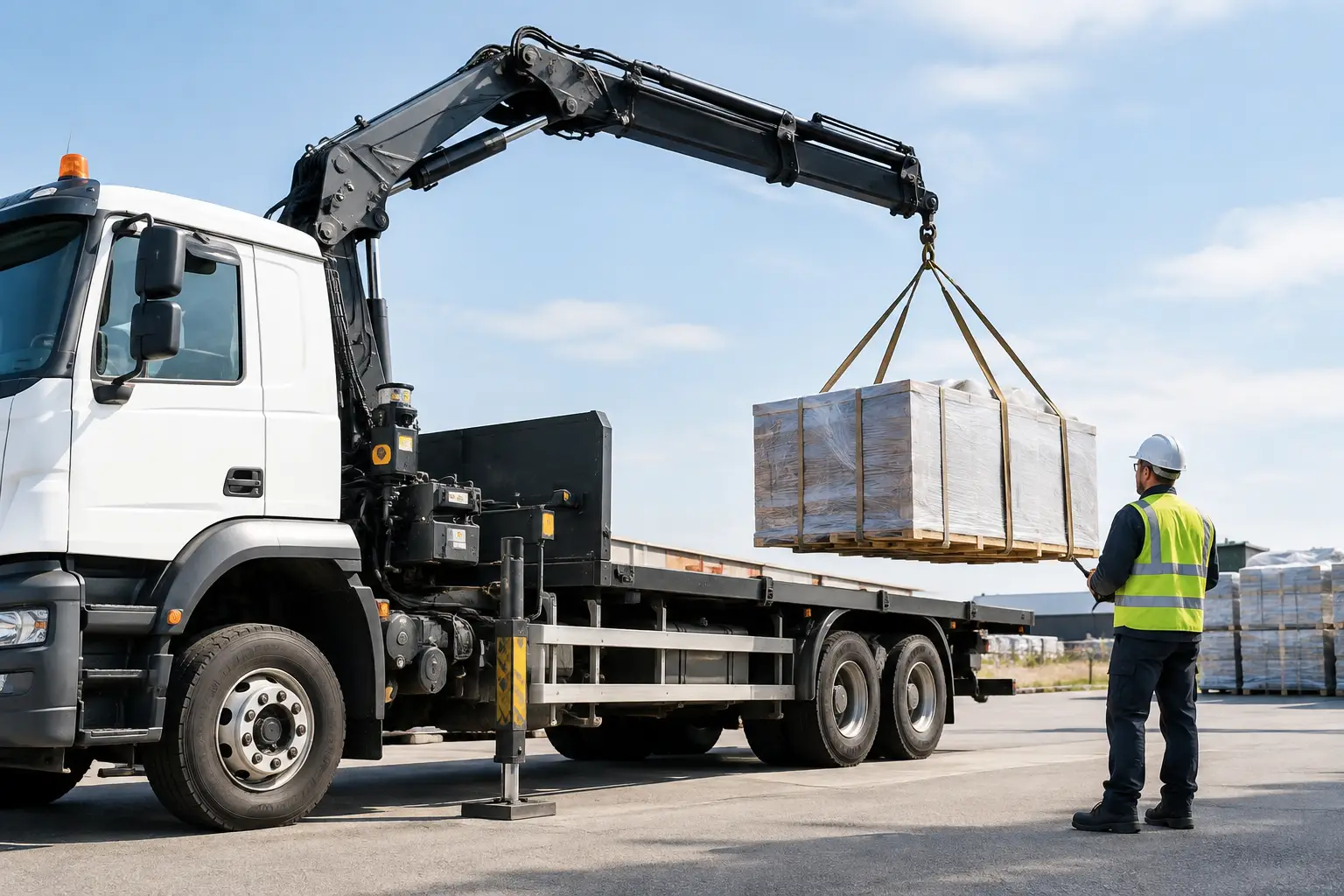
A critical pump skid has arrived at a regional workshop, but there is no forklift, loading dock or telehandler available to unload it. This is when is a Hiab needed becomes a practical operations question, not just a transport choice. If freight must be lifted from the truck and placed precisely at delivery, a crane truck can remove a major delay point and keep work moving.
A Hiab is commonly used to describe a truck-mounted hydraulic crane. It combines road transport with lifting capability, allowing a driver to collect, carry, unload and position freight without relying on customer lifting equipment. For mine sites, construction projects, maintenance teams and industrial facilities, that control can be the difference between an efficient delivery and equipment sitting on a vehicle awaiting resources.
When Is a Hiab Needed?
A Hiab is needed when the freight cannot be safely loaded or unloaded by hand and there is no suitable lifting equipment at one or both ends of the job. It is particularly valuable where the load is heavy, awkward, palletised, oversized or required to be placed somewhere other than directly beside the truck.
The key point is that a standard freight vehicle moves cargo, while a Hiab truck moves cargo and provides an on-board lifting solution. That reduces coordination with forklifts, telehandlers, mobile cranes and separate lifting crews. It also reduces handling steps, which matters when freight is time-critical, high-value or vulnerable to damage.
A Hiab is not automatically the right vehicle simply because an item is heavy. The lift weight, dimensions, centre of gravity, required reach, site conditions and access all need to be assessed. A compact, dense item can exceed crane capacity at a long reach, while a larger but lighter load may be straightforward to place close to the vehicle.
Situations That Usually Require a Crane Truck
No forklift or unloading plant on site
This is the most common reason to book a Hiab. Regional depots, remote work fronts, temporary compounds and smaller industrial yards may not have a forklift available when the delivery arrives. Even where a forklift exists, it may be committed elsewhere, unsuitable for the load, unlicensed for site use or unavailable after hours.
A Hiab gives the delivery its own unloading capability. For urgent parts and breakdown freight, this avoids waiting until the next shift or arranging external plant hire. It is especially useful for 24/7 operations where timing is driven by downtime, not normal receiving hours.
The load needs controlled placement
A crane truck is appropriate when freight must be placed onto dunnage, inside a fenced compound, beside a work area, onto a concrete pad or over an obstacle. The ability to lift and slew the load provides more control than simply placing it at the rear of a trailer.
Examples include switchboards, generators, pump assemblies, site containers, steel components, plant attachments and machinery crates. The required placement area must still be accessible and prepared, but the crane provides a practical solution where a standard tail lift or forklift delivery will not work.
Freight is too heavy or awkward for manual handling
Large industrial components are rarely suited to manual unloading. Weight is only one factor. Long pipe sections, fabricated steel, irregular machinery parts and crated equipment can be difficult to control even if their total mass appears manageable.
A Hiab allows the load to be lifted with the correct rigging and placed steadily. This supports safer handling and reduces the likelihood of damaged freight, damaged vehicles or injuries caused by improvised unloading. Loads must be properly secured for transport and have suitable lift points or an approved lifting method before collection.
Collection and delivery both need lifting support
Sometimes the issue starts at pickup. A supplier may have freight ready on the ground but no loading equipment, or a site may need an item removed before replacement equipment can be installed. A Hiab can manage lifting at both ends, subject to the load details and site conditions.
This is useful for equipment swaps, shutdown mobilisation, recovery of failed components and direct movements between industrial locations. Instead of organising separate lifting resources at each end, the transport vehicle arrives equipped to complete the job.
Access is constrained or the delivery is remote
Remote WA deliveries often involve uneven ground, limited hardstand areas and restricted access near the final drop point. A Hiab can place freight from a suitable standing position where another vehicle type may struggle to complete the unload.
That does not mean a crane truck can work safely anywhere. Soft ground, side slopes, overhead powerlines, poor turning space and unstable surfaces can prevent a lift. Outriggers need firm, level ground, and the site needs enough clear space to establish an exclusion zone. Early planning prevents the vehicle arriving only to find that the lift cannot proceed.
What Information Is Needed Before Booking a Hiab?
A reliable Hiab job starts with accurate freight and site information. Sending a weight estimate alone is not enough. The transport provider needs to understand what is being lifted, where it is being picked up, where it is going and exactly where it must be placed.
Provide the overall dimensions, confirmed weight, photos and details of any lifting points. Identify whether the item is on a pallet, skid, stillage or loose on the ground. For machinery and fabricated items, advise whether the load has a known centre of gravity and whether certified lifting lugs are fitted.
Site details matter just as much. Confirm truck access, entry restrictions, ground condition, overhead hazards, delivery hours and induction requirements. Mine sites and major industrial facilities may require advance booking, documentation, site-specific safety equipment and a nominated contact to receive the load.
For more complex lifts, share a clear description of the intended placement location. A photo taken from the truck access point towards the final position can be more useful than a general site image. It helps assess reach, obstructions and whether a different crane size or lifting method is required.
Hiab Capacity Depends on Reach, Not Just Load Weight
One of the most common planning errors is assuming crane capacity is fixed. A Hiab may lift a heavier load close to the truck and a much lighter load when the boom is extended. This is because lifting capacity reduces as the working radius increases.
For example, a unit may be within capacity when lifted from directly beside the vehicle but unsuitable when it must be placed several metres over a fence or behind a barrier. The truck also needs room to deploy outriggers safely. If the delivery point is tight, a site inspection or additional planning may be needed.
This is why the phrase “it is only a one-tonne load” does not always answer the question. The load weight, boom reach, load shape, lift points, ground bearing capacity and vehicle position must work together. A competent transport operator will assess these factors before confirming the job.
When a Hiab May Not Be the Best Option
A Hiab is highly versatile, but it is not a replacement for every lifting solution. A forklift may be more efficient for repeated pallet movements inside a warehouse. A mobile crane may be required for very heavy lifts, significant radius, complex rigging or lifts over structures. A tilt tray may be better for wheeled equipment that needs to be driven or winched on and off.
A standard tautliner, flat-top or trailer may also be the better value option where loading equipment is available at both ends and the freight only needs conventional handling. Choosing a Hiab when it is not required can add unnecessary cost and reduce payload capacity. Choosing a standard vehicle when lifting is required can create a more expensive delay at delivery.
The right decision comes down to the full task, not just the road journey. Consider the collection method, transport route, access conditions, lifting requirement, placement point and delivery deadline together.
Planning Hiab Freight for Time-Critical Work
For breakdowns and shutdowns, the best time to identify a Hiab requirement is before dispatch. Waiting until the truck is loaded to confirm unloading arrangements can put the job at risk, particularly for regional or remote delivery runs.
PTWA plans dedicated crane-truck movements around the freight, the lift and the destination requirements, rather than treating the lift as an afterthought. Direct transport, live GPS visibility and delivery confirmation give operations teams clearer control when critical equipment is moving to site.
If the freight needs to be lifted, positioned or recovered and the destination cannot provide suitable plant, specify that requirement at the first call. A correctly planned Hiab delivery arrives ready to complete the task, not just park at the gate.