
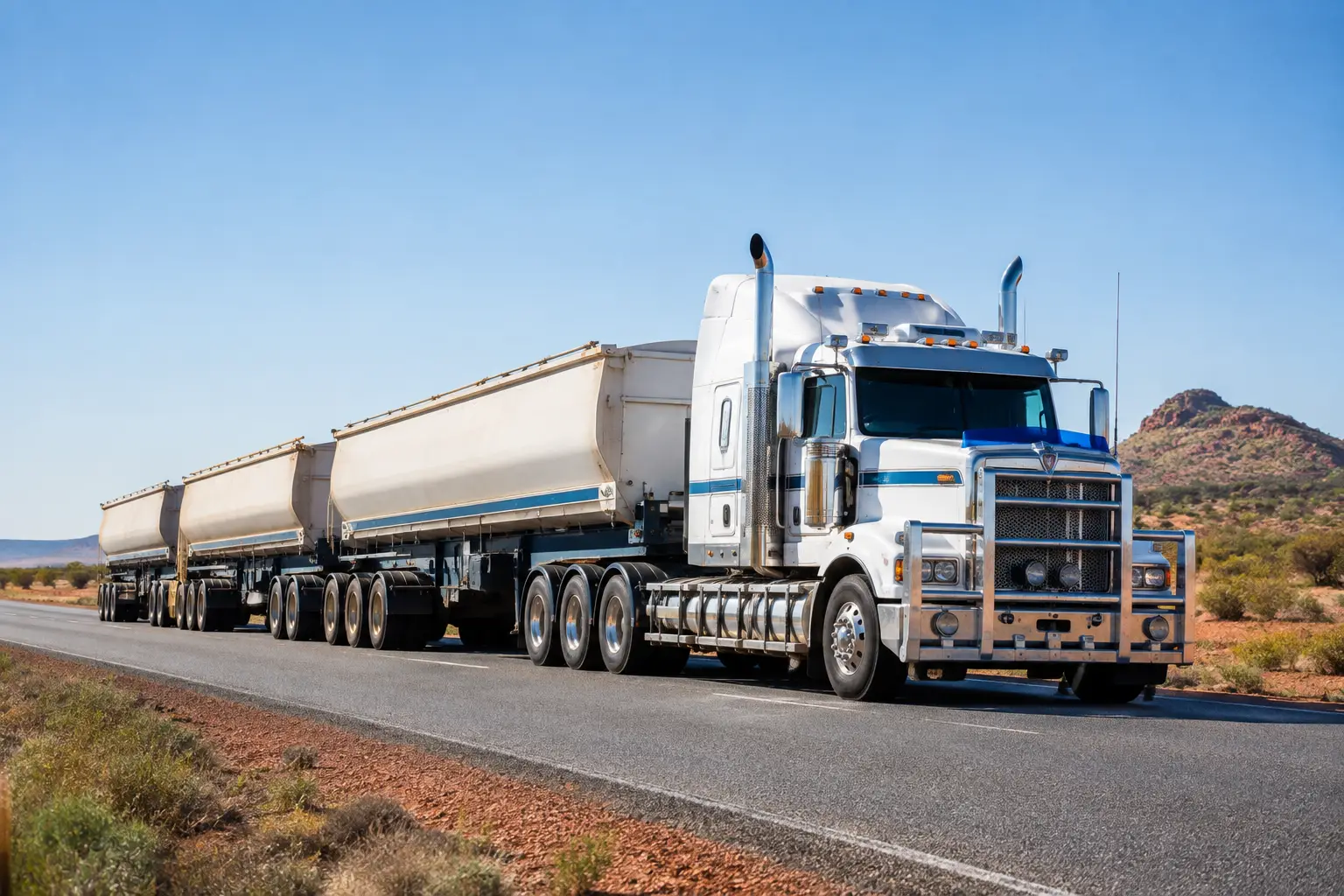
A road train held at the gate or stopped short of a restricted corridor can turn a planned delivery into costly downtime. Road train permits are not a paperwork exercise to leave until the vehicle is loaded. They are a route, vehicle, load and timing decision that must be resolved before dispatch - particularly when freight is heading to a regional or remote industrial site.
For mining, construction and heavy industry, the issue is rarely just whether a combination can physically carry the load. The question is whether that exact combination can legally operate on the intended road network, at the required mass and dimensions, under the operating conditions set for that route. Getting it right protects the schedule, the driver, other road users and the customer’s site access plan.
What road train permits are designed to control
A road train permit authorises, or helps establish authorisation for, a heavy vehicle combination to operate outside the standard access arrangements that apply to smaller vehicles. In practice, access may be governed by a permit, a network notice or another approved access framework. The correct pathway depends on the vehicle configuration, dimensions, mass, route and operating conditions.
This matters because a triple road train, AB-triple or other multi-trailer combination is not automatically approved for every road in Western Australia. A route may be suitable for one configuration but not another. Access can also change at the point where a state highway meets a local road, a townsite, a mine access road or a restricted bridge.
Permit conditions commonly deal with vehicle combination details, approved roads, axle and gross mass limits, travel times, lighting and signage, escort requirements, speed restrictions, and the need to comply with directions at particular structures or intersections. A condition is not optional simply because the delivery is urgent. If the permit does not match the task, the vehicle should not roll.
Start with the actual transport task
The fastest way to lose time is to request approval using incomplete information. Before a road train is allocated, the transport operator needs a clear picture of the job: what is being moved, where it is collected, where it must be delivered, and what equipment will perform the work.
The load profile matters as much as the total weight. A compact, dense item may create axle-group issues even when gross mass appears acceptable. Long steel, plant components, pipe, machinery or crated equipment can introduce rear overhang, width, height or load-restraint considerations. A vehicle that is acceptable for general freight may not be the right combination for a particular piece of shutdown-critical equipment.
Route planning must also account for the full journey, not just the long regional leg. The first and final kilometres often create the restriction. Can the vehicle clear the collection point? Is there turning room at the receiver? Are there site booking times, curfews, gate requirements, pilot vehicle rules or radio call-up procedures? If the delivery is to a mine site, confirm site induction, chain-of-responsibility documentation and unloading arrangements before the truck is committed.
The vehicle configuration must match the approval
Road train approvals are tied to specific operating configurations. Changing the prime mover, trailer set, axle spacing, tyre arrangement or load distribution can affect whether the planned access remains valid. So can adding equipment that changes dimensions, such as a crane attachment, lifting frame or different load restraint system.
Do not assume an existing permit covers a substitute vehicle. During a breakdown, capacity squeeze or urgent after-hours uplift, that assumption can create a compliance issue at precisely the moment the freight is most critical. A capable operator checks the actual combination against the approved arrangement before dispatching.
The permit process needs time and accurate data
Road train permits should be treated as part of job mobilisation, not as an admin task after the transport plan is confirmed. Some movements can proceed under established network access arrangements where every requirement is met. Others require a permit application, route assessment or approvals from road managers. Lead times vary according to the complexity of the movement and the authorities involved.
For a straightforward, repeatable route with a standard configuration, the process may be relatively predictable. It becomes more involved where there is non-standard mass, oversize dimensions, restricted infrastructure, a new destination, a local-government road, or an unusual combination. An urgent job does not remove these constraints. It simply makes early, accurate coordination more valuable.
The core information should be checked before an application or access enquiry is made: vehicle and trailer details, axle spacings, tare weights, proposed loaded axle masses, loaded height, width and length, load description, pickup and delivery locations, intended route, travel dates and any site-specific conditions. If one of these inputs changes, the access decision may need to be reviewed.
For time-sensitive freight, build a contingency route where practical. A closure, floodwater, roadworks program or bridge restriction can affect a permitted path with little warning. The operational plan should identify who monitors network changes, who has authority to hold or reroute the load, and how the customer will be updated.
Route compliance is a live operational task
Approval is only the beginning. The driver and operations team need the current documents, clear instructions and a shared understanding of the conditions before departure. This is particularly important for long-distance work where a road train may transition through several road environments and operate across changing weather conditions.
Drivers should receive the approved route and relevant conditions in a usable format, along with load details, site contacts and escalation instructions. If the approved route cannot be followed because of an incident, detour or access issue, the driver should not make a judgement call to use an unapproved road simply to protect an ETA. Operations control needs to assess the alternative and obtain the required direction or approval.
Load restraint also deserves close attention. Heavy industrial freight can shift the centre of gravity, increase restraint demands or create projection hazards. The restraint method must suit the load, trailer and journey, including rougher regional sections where vibration and road surface variation can challenge poorly planned securing arrangements.
Visibility protects the delivery plan
For a maintenance team waiting on a critical component, a vague update that the truck is “on the way” is not enough. They need a realistic delivery position and early warning if the plan changes. Live GPS tracking, direct communication and photographic proof of delivery create accountability around a road train movement, especially where the consignee is remote from the transport control room.
Visibility also supports compliance. When the operations team can see the vehicle’s progress, they can respond to delays, weather events, traffic disruptions or site changes while there is still time to protect the delivery window. It is a practical control, not a customer-service extra.
Common mistakes that delay road train movements
The most expensive mistakes are often made before the keys are handed over. Using a familiar route without confirming current access is one. Another is calculating total payload without checking axle masses after the freight is positioned on the trailers. A third is treating the destination as a postcode rather than a physical access point with gates, turning circles, roads and site rules.
Businesses also run into trouble when procurement, operations and transport work from different versions of the job. The purchase order may say “deliver to site”, while the transport booking omits the nominated laydown area, site contact or required arrival time. For a road train, these gaps can force a wait in an unsuitable location or require an unplanned transhipment.
Avoiding these problems does not mean overcomplicating every movement. It means applying the right level of planning to the risk. A known, repeat route with a standard configuration can be controlled efficiently. A one-off, high-mass or remote delivery needs more verification before the vehicle is committed.
Choosing a transport partner for permitted movements
A provider should be able to explain the proposed configuration, route logic and approval position in plain language. They should ask questions about the load and final access point rather than promising capacity before the details are known. For urgent freight, they also need the operational depth to mobilise a suitable vehicle, maintain communication and manage exceptions without losing control of the job.
PTWA plans dedicated freight movements around the actual delivery requirement - including vehicle selection, route constraints, site access and the customer’s deadline. For critical freight, direct delivery reduces intermediate handling while GPS visibility and delivery confirmation keep the receiving team informed.
The useful question is not simply, “Do we have a road train available?” It is, “Can this approved combination deliver this load to this site, on this route, under current conditions?” Answer that before dispatch, and the transport plan has a far better chance of arriving as promised.