
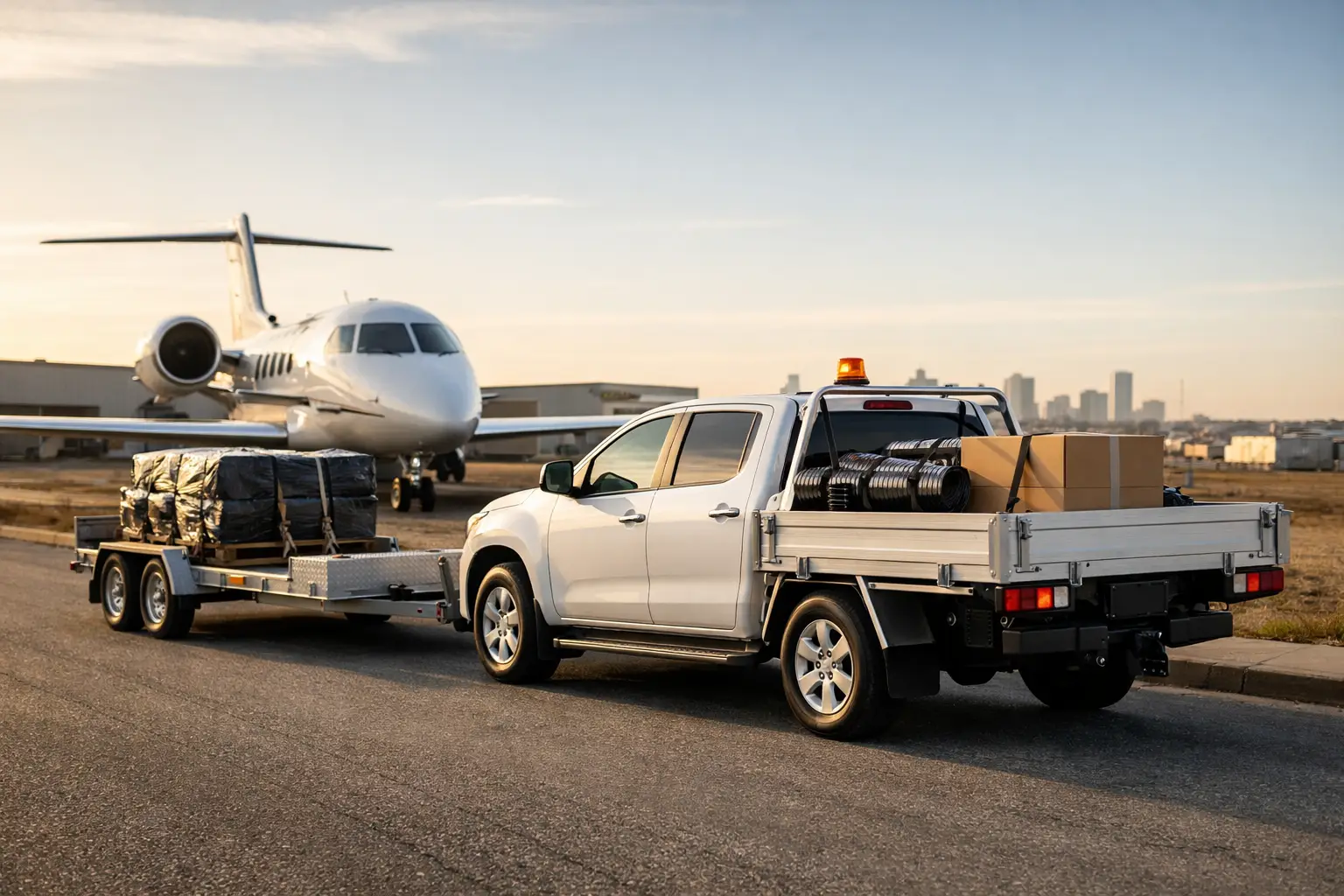
A shutdown does not wait for a courier run tomorrow morning. When a critical part is missing, site paperwork has to reach a regional depot, or a breakdown has parked up expensive equipment, light vehicle hotshots Perth services are often the fastest and lowest-risk way to move freight immediately. The right job on the right vehicle can save hours, reduce handling, and get urgent freight where it needs to be without the delays that come with depot networks or shared loads.
For Perth businesses, mining operations, maintenance teams and freight brokers, light vehicle hotshot work is not just about speed. It is about control. A dedicated ute, van or similar light vehicle can be dispatched quickly, loaded directly, and driven straight to site, workshop, warehouse or customer with no cross-docking in between. That matters when every extra touchpoint increases the chance of delay, damage or confusion.
What light vehicle hotshots Perth actually covers
In practical terms, light vehicle hotshots Perth usually refers to urgent direct-delivery freight moved on smaller dedicated vehicles. That can include utes, vans and other light commercial vehicles suited to time-critical consignments that do not need a larger rigid, semi-trailer or oversize combination.
This service is commonly used for parts, tools, electrical components, breakdown supplies, mining consumables, small pallets, cartons, urgent documents and specialist items that must move now rather than sit in a standard linehaul queue. The freight might be going across Perth metro, into industrial corridors, out to regional centres, or onward to remote mining and oil and gas locations across Western Australia.
The advantage is not simply that a light vehicle can leave sooner. It is also easier to route, quicker to load, and often better suited to sites where access is tighter or the load itself does not justify a larger truck. If the freight is small enough to move safely on a dedicated light vehicle, using bigger equipment can add unnecessary cost and complexity.
When a light vehicle is the right call
There is no value in over-servicing a job. If a dedicated van or ute can do it safely and on time, that is usually the most efficient option.
This is especially true when the freight is urgent but not oversized, when pickup is within a short dispatch window, or when the destination is a workshop, warehouse, plant or mine support location that needs a fast direct run. For metro and short-to-mid-distance regional jobs, a light vehicle can often be mobilised faster than heavier assets, particularly outside normal business hours.
It also suits jobs where handling risk needs to stay low. Sensitive components, priority spares, calibrated equipment and project-critical items all benefit from direct movement on one vehicle from collection to delivery. No depot transfer means fewer delays and fewer chances for the wrong item to be scanned, staged or loaded onto the wrong run.
That said, it depends on the freight profile. If the load is heavier, bulkier, awkward to restrain, or requires lifting equipment, a light vehicle may not be appropriate. Good transport planning is not about forcing every urgent load into the smallest option. It is about matching urgency, dimensions, weight, site requirements and route conditions to the vehicle that gives the best outcome.
Why dedicated delivery matters more than headline speed
A lot of operators talk about urgent delivery. The real question is what happens after pickup.
Dedicated hotshot transport means the freight stays on one allocated vehicle and moves directly to destination. It is not co-loaded with general freight. It does not sit in a depot waiting for a linehaul slot. It is not bumped for a higher-priority consignment because the whole movement is already the priority.
That matters in WA, where distance and remoteness turn minor delays into major operational issues. A few lost hours in Perth can become a full-day problem by the time a load is meant to arrive at a regional workshop or remote site. For mining and industrial clients, that can mean crew downtime, missed maintenance windows or equipment standing idle while a single part is still in transit.
With dedicated light vehicle hotshots Perth services, the control point is much clearer. Pickup happens, the freight is loaded, tracking begins, and the vehicle runs direct. If there is a route issue, access hold, weather delay or site constraint, you know about it in real time rather than after the fact.
Where light vehicle hotshots fit in WA operations
Perth is the dispatch base for a large share of urgent freight moving across the state. Parts come in through metro suppliers, fabrication shops, warehouses, ports and airport facilities, then need to be moved quickly to where the operational problem actually is.
That could be a run from Welshpool to Kwinana, from Malaga to Henderson, or from Perth straight out to a regional centre. It could also be the first leg of a longer urgent movement into mining country where timing is tied to a shutdown schedule or a live equipment issue.
This is where a provider with broader transport capability has an advantage. Not every urgent job stays a light vehicle job. Sometimes the first call starts with a carton of parts and turns into a larger equipment movement, a repeat-lane requirement, or a linked logistics task involving warehousing, labour, site delivery coordination or after-hours support. The strongest operators can scale the response without losing momentum.
What business customers should expect from a serious provider
If you are booking urgent freight, speed on its own is not enough. You need certainty around execution.
A proper hotshot service should be available 24/7, with rapid dispatch capability in Perth and a clear understanding of where the freight is going. That includes mine-site delivery constraints, inductions, chain of responsibility requirements, load restraint, fatigue management and the practical realities of long-distance WA transport.
Visibility is another non-negotiable. Live GPS tracking, real-time updates and photographic proof of delivery are not nice extras on critical freight. They are part of maintaining operational control. Procurement teams, site coordinators and logistics managers need to know when the freight has been collected, where it is, and when it has been delivered.
Responsiveness also has to mean more than answering the phone. It means asking the right questions at booking stage - dimensions, weight, handling requirements, delivery contacts, site access details, booking references and time-critical constraints - so the job is dispatched correctly the first time.
Light vehicle hotshots Perth and the mining sector
Mining logistics has a lower tolerance for mistakes than general courier work. Site access can be controlled, delivery windows can be tight, and the cost of delay is usually far higher.
That is why light vehicle hotshots Perth work for mining clients needs to be handled with an operational mindset, not a parcel mindset. The freight may be small, but the consequence of it arriving late can be significant. A seal kit, sensor, pump component, electrical item or specialist tool can be the difference between a fast repair and a prolonged stoppage.
In these jobs, reliability comes from process. The vehicle is allocated directly, the route is managed properly, communication stays active, and delivery is completed with proof. Where longer-distance runs are involved, non-stop options with dual drivers may also be relevant, depending on the urgency and load profile.
This is where PTWA fits naturally for WA businesses that need more than a basic urgent courier. The service model is built around direct vehicle allocation, live visibility, remote coverage and the practical demands of industrial freight.
The trade-off between cost and downtime
Hotshot transport costs more than standard freight because it is dedicated and immediate. That is the point. You are paying for direct allocation, reduced handling, priority dispatch and time certainty.
The better question is whether standard freight is actually cheaper once downtime is factored in. If a delayed delivery holds up a maintenance crew, extends a shutdown, pushes out a production schedule or leaves critical equipment offline, the freight saving can disappear quickly. For many industrial customers, the premium on hotshot transport is minor compared with the cost of waiting.
Still, not every job needs a hotshot. If the freight is not time-critical, if there is buffer in the schedule, or if consolidation makes sense, another transport mode may be better value. The right provider will tell you that, rather than pushing an urgent service where it is not required.
Choosing the right operator for urgent direct freight
Capability matters more than marketing language. Ask how quickly they can dispatch in Perth, whether the load will be dedicated or co-loaded, how they handle regional and remote WA deliveries, and what tracking and proof of delivery they provide.
Also ask whether they understand your delivery environment. A mine-site run, shutdown support movement or urgent industrial delivery is not the same as a same-day metro parcel. Site contacts, access requirements, safety compliance and freight presentation all need to be managed properly.
When the job is urgent, the simplest model is often the strongest one: one vehicle, one load, one direct route, one accountable provider. That is what makes light vehicle hotshots effective.
If your freight is small enough for a ute or van but critical enough that waiting is not an option, a dedicated hotshot service gives you the fastest path from problem to delivery - and in WA operations, that time difference can be the thing that keeps the whole job moving.