
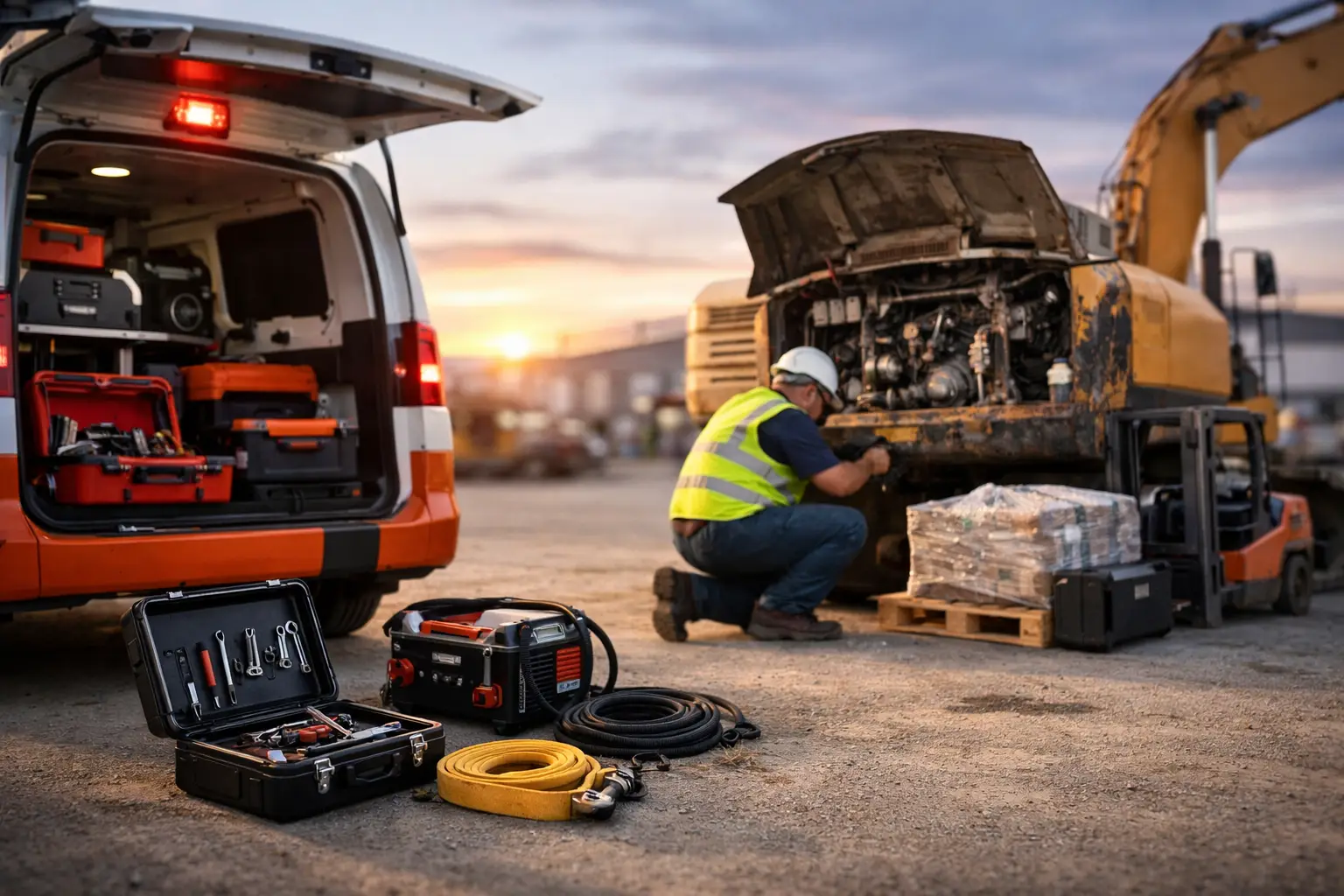
A failed hydraulic pump, damaged conveyor component or unavailable generator part can stop far more than one machine. Crews stand down, schedules slip, contractors wait and downtime costs begin accumulating immediately. Emergency logistics for equipment breakdowns is the process of getting the right freight from its current location to the worksite without adding depot delays, unnecessary handling or uncertainty to an already urgent situation.
For maintenance and operations teams, the issue is rarely just transport. The real pressure comes from confirming the correct part, arranging site access, selecting a suitable vehicle and proving exactly where the freight is at every point in the journey. The transport plan needs to be built around the recovery window, not a standard freight timetable.
Why equipment breakdown freight needs a different response
Standard freight networks are designed for consolidation and planned delivery runs. That model can work for replenishment stock, but it creates risk when a critical component is needed to return a plant, workshop or mine site to service. Freight may wait for collection cut-offs, pass through multiple depots or be co-loaded with other consignments. Every handover adds time and another opportunity for misrouting, damage or a missed delivery instruction.
A breakdown response requires direct control. The freight should be collected on a dedicated vehicle and delivered point to point, with no intermediate depot transfer or co-loading. This is particularly valuable when the item is high-value, fragile, unusually shaped or required during a shutdown window.
It also depends on the actual recovery requirement. A small seal kit may need a ute or van dispatched immediately. A replacement motor, gearbox or pump skid may need a crane truck, Hiab or suitably rated trailer. Sending the wrong vehicle wastes the first hour, which is usually the most valuable hour of the job.
The first hour sets the recovery timeline
When equipment fails, transport should be engaged as soon as the required part is identified, not after procurement has finished every administrative step. A capable emergency freight provider can begin planning while final collection details are being confirmed.
The dispatcher needs clear operational information: collection address and contact, delivery site, required delivery time, freight dimensions and weight, lifting points, dangerous goods status if relevant, and any packaging limitations. Site requirements matter just as much. Remote industrial locations may require inductions, licences, PPE, vehicle standards, escort arrangements or pre-booked delivery slots.
Accuracy is more useful than optimism. If the part is not physically ready for collection, say so. If a site is only accessible before a shift change, identify that constraint early. The best emergency transport plan is not simply the fastest theoretical route. It is the fastest workable route that gets the freight through the gate, unloaded safely and handed to the person who needs it.
Confirm the freight before the vehicle moves
Misidentified parts are a common and expensive breakdown problem. A component can look right on a packing list but have the wrong serial number, flange configuration or electrical specification once it reaches site. Before dispatch, confirm the part number, quantity and any associated fittings, seals, adaptors or documentation needed to install it.
Photographs are useful for awkward freight, particularly where loading methods or restraint requirements are unclear. They help the transport team select equipment, plan load restraint and avoid arriving with a vehicle that cannot safely collect the item. For oversized or heavy items, dimensions and weights must be verified rather than estimated.
Choosing the right vehicle for the breakdown job
Vehicle selection should match the freight, route and delivery conditions. Speed matters, but so does the ability to load, secure and unload the item without relying on lifting equipment that may not be available after hours.
For lightweight urgent parts, a dedicated ute or van can often provide the fastest mobilisation and direct access to workshops, warehouses and metro industrial sites. Rigid trucks and semi-trailers suit larger components, palletised freight and higher payloads. Where the receiver cannot unload independently, a crane truck or Hiab can remove a major constraint from the job.
Long-distance movements need a separate decision. A single driver may be appropriate where the delivery window allows for regulated rest breaks. For a critical Perth-to-regional or remote delivery with no time to lose, dual-driver transport can keep the vehicle moving continuously while maintaining fatigue compliance. It costs more than a standard service, but the comparison should be against lost production time, not against an ordinary freight rate.
Emergency logistics for equipment breakdowns in remote WA
Remote deliveries add layers that do not exist on a metro run. Distances are longer, mobile coverage can be intermittent, road conditions vary and site access is often tightly controlled. A part that leaves Perth quickly is not useful if it reaches a mine gate without the correct booking, driver documentation or receiving contact.
The transport provider needs to understand the full delivery chain: the route, fuel planning, site access process, after-hours contacts and unload method. Weather and road closures can change the plan at short notice, particularly during wet-season conditions in northern regions. In these cases, certainty comes from active coordination, not from an estimated arrival time issued at collection.
For shutdown work, delivery timing may be even more critical than transit speed. Equipment and labour are scheduled in sequence, so a late component can hold up several downstream tasks. Dedicated transport keeps the job focused on one consignment and one deadline, rather than fitting it into a broader network schedule.
Visibility is part of the emergency service
Operations teams should not have to chase multiple people for an update while a machine is offline. Live GPS tracking, direct communication with dispatch and real-time delivery updates give the maintenance team a clear basis for planning labour, lifting equipment and installation work.
Proof of delivery also matters. A signed or photographic confirmation verifies that the freight reached the correct site and was handed over as instructed. On large industrial sites, delivery to the gate is not always delivery to the workshop. The final handover location should be clear from the outset.
Visibility does not remove every risk. Road conditions, loading delays and site restrictions can still affect a job. What it does provide is early warning and accountability, allowing the customer to adjust the recovery plan before a minor delay becomes an operational surprise.
Build a breakdown freight plan before the next failure
Emergency transport works best when key details are already known. Maintenance teams do not need a complicated manual, but they should keep current supplier contacts, common part specifications, site access requirements and after-hours receiver details available to the people who will make the call.
It is also worth identifying which components have the highest downtime impact. These may justify pre-arranged transport procedures, priority supplier collection authority or local stockholding. For some businesses, a planned warehousing or 3PL arrangement reduces response time by positioning critical spares closer to the point of use. For others, the requirement is simply a reliable 24/7 provider that can collect from wherever the part is available.
A practical plan should cover four questions: who can approve the movement, where the part is likely to be collected, what vehicle may be required and who can receive it at site. If those answers are available at 2 am, dispatch can begin without losing time to internal escalation.
When dedicated transport is the right call
Not every equipment issue requires a hotshot vehicle. If the equipment has redundancy, the repair can wait and the part is not operationally critical, a planned freight service may be the sensible commercial choice. The decision changes when downtime is active, the recovery window is fixed, freight is difficult to handle or the delivery point is remote and restricted.
Dedicated emergency transport is most valuable when a direct delivery prevents a larger loss. It provides one vehicle, one accountable transport team and a freight movement designed around the job rather than a carrier's network. PTWA applies that approach with 24/7 dispatch, dedicated vehicles, GPS visibility and delivery confirmation for urgent industrial freight across Western Australia.
The next breakdown will not arrive at a convenient time. Having the freight details, approval path and direct-delivery option ready means the response can start with action instead of uncertainty.