
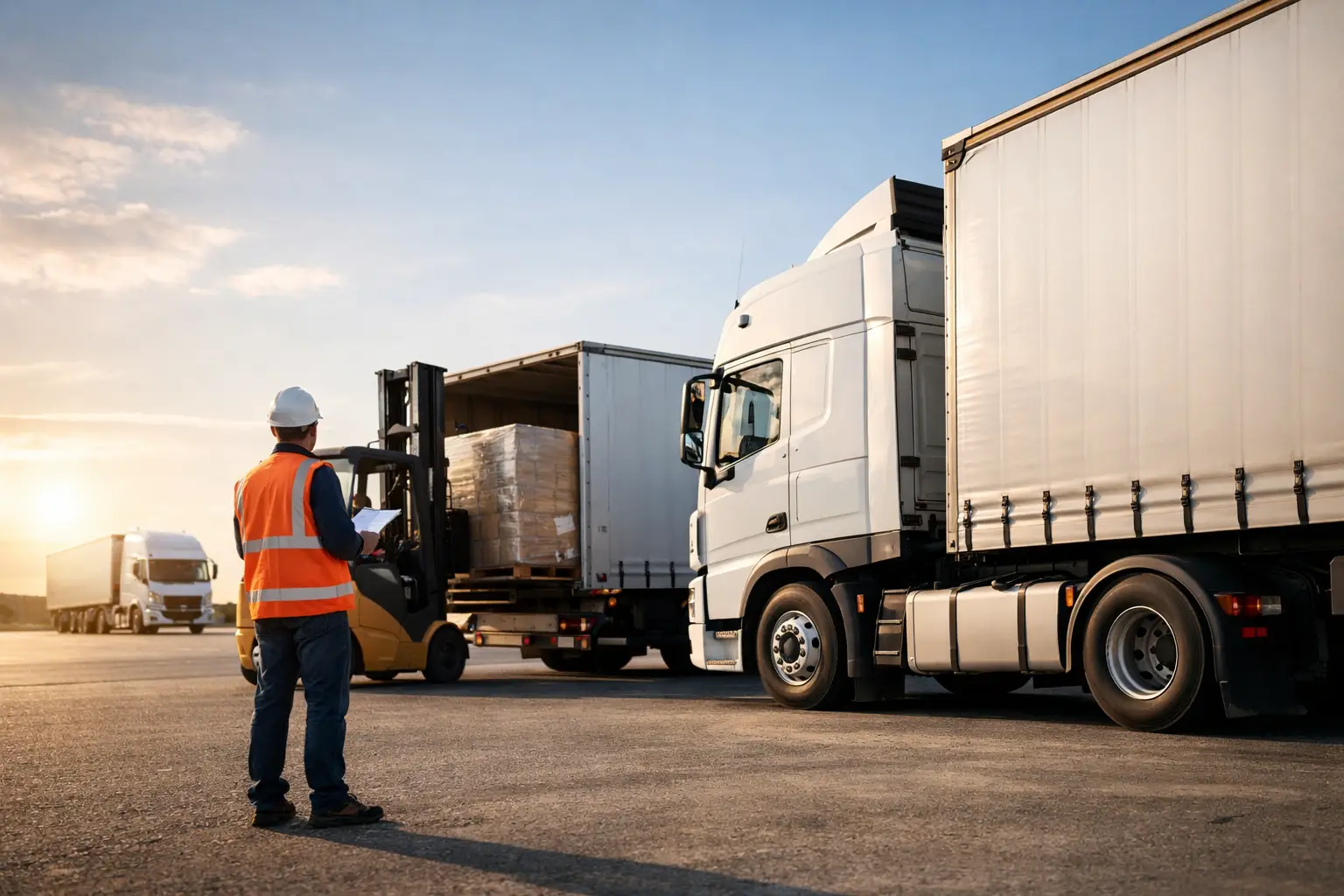
A shutdown can slip by hours because one part is sitting in the wrong depot queue. A dedicated direct freight service is built to stop that from happening. Instead of being co-loaded, cross-docked or handed between terminals, the freight goes on one allocated vehicle and stays there until delivery.
For operations teams, procurement staff and site coordinators, that difference is not minor. It changes how much control you have over timing, chain of custody and site readiness. When the freight is critical, the transport model matters just as much as the vehicle.
What a dedicated direct freight service actually means
In practical terms, dedicated direct freight service means one job, one vehicle, one delivery path. The vehicle is assigned to your freight alone and travels directly from collection to destination without depot transfers or intermediate handling.
That matters because every extra touchpoint adds delay and risk. Freight that moves through a hub-and-spoke network can be scanned, unloaded, sorted, reloaded and reprioritised several times before it reaches site. That may suit general freight moving on a flexible timetable, but it is a poor fit for urgent mine-site parts, shutdown equipment, time-sensitive documents or high-value industrial components.
Direct service also improves accountability. When a single vehicle carries the load from pickup to delivery, there is less ambiguity around where the freight is, who has it and what happens next. For businesses running tight maintenance windows or remote project schedules, that visibility is often as important as speed.
When dedicated direct freight service makes commercial sense
Not every load needs a dedicated vehicle. If the freight is low urgency, easily replaceable and not tied to operational downtime, a standard consolidated option may be more cost-effective. Good logistics decisions are not about using the fastest option every time. They are about using the right level of service for the consequence of delay.
Dedicated direct freight service makes sense when the cost of waiting is higher than the cost of priority transport. That usually includes breakdown response, shutdown support, emergency stock replenishment, site-critical consumables, specialised tools, compliance documents and equipment needed for a booked crane, crew or maintenance team.
It also makes sense when the freight is sensitive to handling. Fragile components, calibrated equipment, awkward industrial freight and high-value items all benefit from staying on one vehicle. Fewer handovers generally mean fewer opportunities for damage, misrouting or loss.
In Western Australia, distance changes the equation again. A part needed in the Pilbara, Goldfields or Mid West is not just moving further. It is moving into a transport environment with tighter site windows, harsher operating conditions and fewer easy recovery options if something goes wrong.
Why direct delivery matters in WA
WA logistics is not a standard metro courier problem at larger scale. Perth freight can usually be recovered with another run, another driver or another same-day option. Remote and regional freight is different. If a load misses a delivery window to a mine or industrial site, the consequences can cascade quickly.
Site access requirements, fatigue management, permit planning, weather, road conditions and unload capability all affect execution. So does the simple fact that many destinations are a long way from the nearest fallback option. When freight is travelling hundreds or thousands of kilometres, every unnecessary stop becomes more expensive.
A direct model gives operations teams tighter control over that journey. Pickup happens faster, routing stays simpler and communication is cleaner. If the run needs dual drivers for continuous movement, that can be planned from the start rather than trying to bolt urgency onto a standard linehaul process.
For WA businesses, the real value is certainty. You are not only paying for a vehicle. You are paying to remove variables.
The operational advantages of dedicated direct transport
Speed is the obvious advantage, but it is not the only one. A dedicated direct movement reduces dwell time because the vehicle is not waiting for other consignments to be loaded, sorted or matched to a route. Once the freight is ready, it moves.
Handling risk drops as well. No depot transfer means no extra forklift movements, no staging in shared freight areas and no avoidable reloads. That is particularly relevant for equipment that is oversized, oddly shaped, fragile or expensive to replace.
Tracking and communication are also stronger in a direct model. With one vehicle on one task, location updates are clearer and ETA changes are easier to report in real time. For customers who need live GPS visibility, milestone updates and photographic proof of delivery, dedicated transport supports that level of service more naturally than a multi-leg network movement.
There is also a compliance benefit. Industrial and mining deliveries often involve specific PPE standards, induction requirements, delivery contacts and site instructions. When the transport provider understands those requirements before dispatch, the risk of site refusal or handover delay is reduced.
Where dedicated direct freight service can fall short
A direct service is not the cheapest option on paper, and that is the main trade-off. You are paying for exclusive vehicle allocation, priority handling and a route built around your freight rather than someone else’s network efficiency.
That cost is justified when delay would trigger downtime, contractual exposure or avoidable labour waste. It is harder to justify for routine freight with broad delivery tolerance. Businesses that use dedicated transport well usually reserve it for loads where urgency, sensitivity or operational impact is clear.
It also depends on provider capability. A direct model only works if the operator can actually dispatch quickly, match the right vehicle to the task and manage the route end to end. If a provider offers direct transport but lacks fleet depth, after-hours coverage or remote WA experience, the promised control can disappear fast.
Choosing the right vehicle for the job
Dedicated direct freight service is not a single vehicle type. The transport method needs to match the freight dimensions, weight, loading requirements, destination and urgency profile.
A small urgent consignment might be best moved by ute or van if speed through metro Perth is the priority. Heavier palletised freight may need a rigid truck. Larger industrial loads could require a semi-trailer or B-double, while site deliveries involving self-unloading may call for a crane truck or Hiab. Oversized freight adds another layer, with route planning, permits and escort considerations coming into play.
This is where experience matters. The fastest dispatch is not useful if the wrong asset turns up and the load has to be rebooked. Good direct-service planning starts with the freight profile and destination constraints, then works back to the vehicle and crew configuration.
What business customers should ask before booking
If the freight is urgent, the right questions are straightforward. Can the provider dispatch now or within a defined window? Will the freight stay on one vehicle from pickup to delivery? Is there live GPS tracking? Can they deliver to regional or remote WA sites without handing the load off? Do they understand mine-site and industrial access requirements?
It is also worth asking how exceptions are handled. If there is a road closure, late pickup, changed contact person or site delay, you need to know who is monitoring the run and how updates will be communicated. In time-critical freight, silence causes almost as much damage as delay.
Providers with genuine dedicated capability will answer those questions directly. They will also talk clearly about limitations, because not every route, load or timeframe is realistic. That honesty is useful. In freight, certainty beats optimism.
Why dedicated direct freight service is often a risk decision, not just a speed decision
Many buyers first approach direct freight as an urgent transport option. That is correct, but incomplete. The bigger value is often risk reduction.
If a part is needed to restart equipment, every hour matters. If a specialised component is damaged in a depot transfer, replacement may take days. If a booked shutdown crew is waiting on one missing item, labour cost can overtake freight cost very quickly. Direct service reduces those exposure points by simplifying the move.
That is why many industrial customers use this model beyond pure emergencies. They use it for high-consequence freight where reliability, control and clean chain of custody matter more than the lowest line-item rate. In that setting, a provider like PTWA is not simply moving freight faster. It is helping protect uptime.
When the freight is critical, the smarter question is not whether dedicated direct delivery costs more than general freight. It is what delay, mishandling or missed site access would cost if you chose the wrong service.