
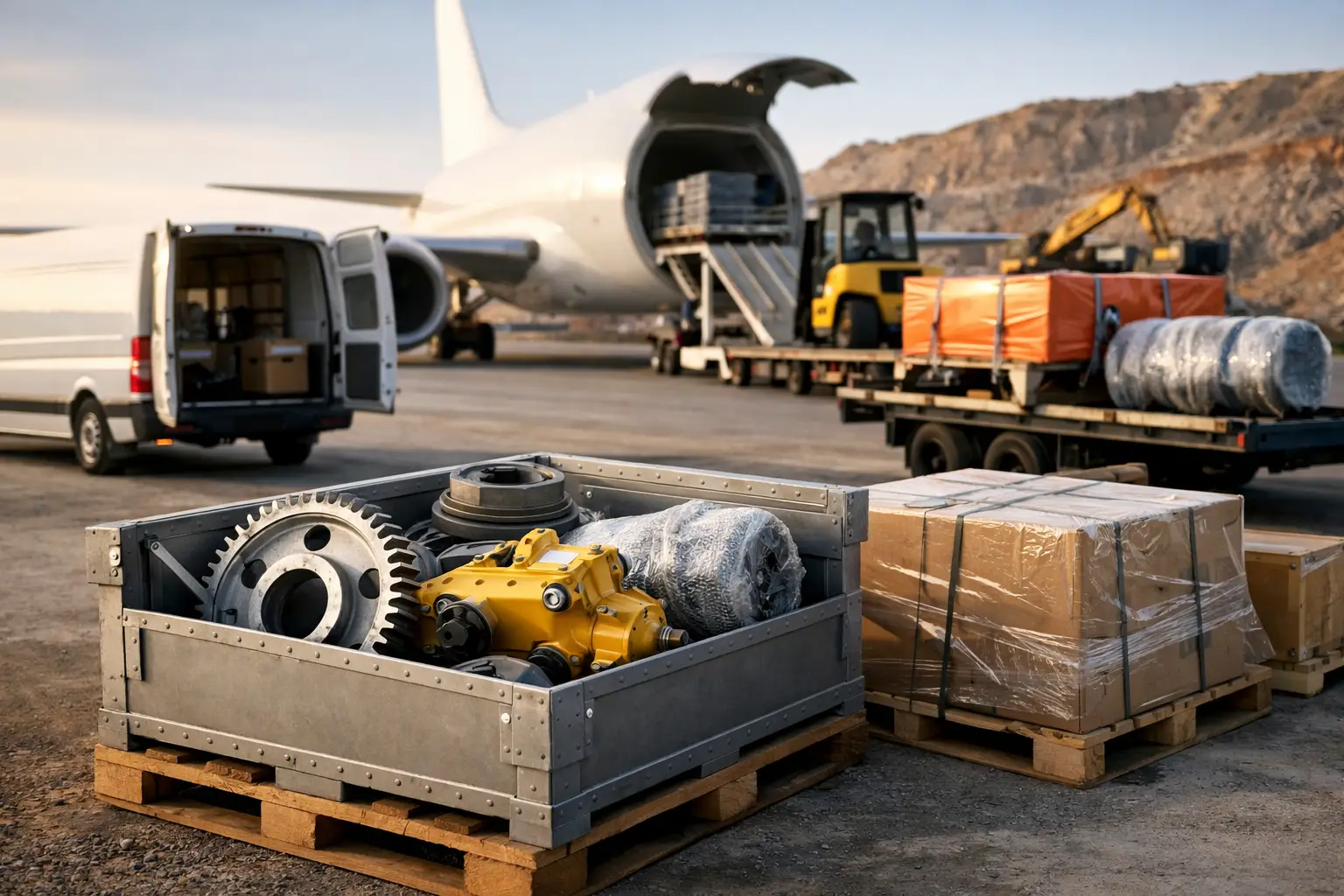
A failed pump, control module or hydraulic fitting can stop an entire workfront while a replacement sits hundreds of kilometres away. This critical spare parts transport guide sets out how to move the right component quickly, safely and with full delivery control when downtime is already costing money.
For mining, industrial and maintenance teams, urgent freight is not simply a fast courier booking. The part must be correctly identified, collected from a known location, secured for transport, cleared for site access and delivered to the person who can put it back into service. A missed detail at any point can turn an overnight recovery into another lost shift.
Define the transport task before dispatch
The fastest vehicle is only useful when the freight and destination information are correct. Before dispatching a critical part, confirm the exact item description, dimensions, weight, packaging condition and any dangerous goods classification. A small boxed sensor may suit a dedicated ute or van. A gearbox, motor or hydraulic power pack may require a rigid truck, crane truck or Hiab for safe loading and unloading.
The urgency also needs a clear operational definition. Ask when the equipment must be available for installation, not just when the freight needs to arrive at the gate. The receiving crew may need time to inspect the part, move it to the workshop and complete a fitment. Working backwards from the required installation time gives the transport provider a real delivery deadline.
It also helps to nominate one decision-maker for the job. Urgent movements often involve procurement, maintenance, stores, site security and a supplier. If instructions are spread across multiple people, details can change without reaching the driver. A single authorised contact keeps collection, delivery and escalation decisions moving.
Capture the information that prevents delay
A dispatch brief should include collection and delivery addresses, site contact numbers, freight dimensions and weight, photos where useful, purchase order or job references, and required delivery time. For remote locations, provide the correct mine entrance, access road, crib room, workshop or laydown area rather than relying on a broad site address.
Include handling requirements early. State whether the item must remain upright, protected from weather, restrained on a pallet, lifted by forklift, or unloaded by a vehicle-mounted crane. If the freight is high value or vulnerable to damage, specify the packaging standard and whether a signed handover is required.
Choose dedicated transport for genuine breakdown freight
For time-critical spare parts, every extra handling point creates risk. Depot transfers, co-loading and scheduled linehaul networks can be economical for routine replenishment, but they are not always appropriate when a shutdown, breakdown or production hold is underway. Freight can wait for consolidation, be unloaded and reloaded, or be separated from the priority information attached to the original booking.
Dedicated direct delivery keeps the part on one allocated vehicle from collection to destination. That gives the sender control over the route, collection time and delivery sequence. It also reduces handling damage, particularly for fragile electronic components, machined parts, calibrated equipment and items that cannot be easily replaced.
The trade-off is cost. A dedicated vehicle is usually priced for the vehicle, driver and urgent allocation rather than as one item within a larger freight run. For a planned stock movement, shared freight may be the sensible choice. For a part that is holding up a plant, drill rig, conveyor or processing circuit, the cost comparison should be made against the cost of lost production and delayed labour.
Match the vehicle to the part and the route
Vehicle selection should reflect more than freight size. A ute can be the quickest option for small urgent components and documents. Vans protect sensitive parts from weather and road dust. Rigid trucks and semi-trailers suit heavier plant components, while crane trucks and Hiabs can remove reliance on lifting equipment at the collection or delivery point.
Remote Western Australian routes add further considerations. Gravel access roads, restricted entry points, wet-season conditions, oversized loads and limited fuel availability can affect travel time and vehicle suitability. A transport plan that looks efficient on a metropolitan map may not work once it reaches a remote site.
For long-distance urgent movements, dual-driver transport may be warranted. Two qualified drivers can keep a vehicle moving through required driver changeovers and reduce avoidable layover time. It is not necessary for every regional job, but it can be decisive where continuous transport is the difference between recovering the next shift and losing another day.
Build site access into the critical spare parts transport guide
A driver arriving at a site without the required induction, booking reference or contact can lose hours at the gate. On mine and industrial sites, access compliance is part of the delivery task, not an administrative afterthought.
Confirm site entry requirements before the vehicle leaves. These may include driver induction status, vehicle inspection requirements, PPE, escort arrangements, delivery bookings, quarantine or biosecurity controls, dangerous goods documentation and load restraint expectations. Some sites have restricted delivery windows, while others require advance notice for heavy vehicles or crane-assisted unloading.
The receiving contact should know the vehicle type, estimated arrival time and driver mobile number where site rules permit. They should also be prepared to direct the driver to the correct unloading point. A truck waiting at a gate because the workshop team is unaware of the arrival is still downtime exposure.
If access conditions are uncertain, raise them at booking. It is better to allow for an escort, alternate vehicle or earlier collection than to discover a compliance issue after the freight is in transit.
Maintain visibility from collection to handover
Urgent freight needs active management, not a booking confirmation followed by silence. Operations teams need to know that the part has been collected, where it is, whether the delivery plan remains on schedule and who accepted it at site.
Live GPS tracking provides a practical view of the vehicle's progress, particularly on long regional runs. Real-time updates allow maintenance coordinators to organise labour and lifting equipment around the actual arrival time rather than an estimate made hours earlier. If road conditions, access delays or a change in delivery instructions affects the plan, the right people can respond early.
Proof of delivery should be specific. A signed record, recipient name, time of handover and photographs where appropriate establish that the part reached the correct location in acceptable condition. This matters when the freight passes from a transport provider to stores, security, a workshop or a field crew.
Visibility should also include escalation. The transport provider needs a clear process for missed contacts, closed gates, unsuitable unloading conditions or freight discrepancies. Fast communication is valuable, but only if it leads to a practical decision: wait, redirect, arrange an escort, return to a safe holding point or dispatch a suitable lifting vehicle.
Protect the part, not just the delivery time
Pressure to move quickly can lead to shortcuts in packaging and restraint. That is a false economy. A damaged replacement part can extend downtime further than a short delay caused by correct preparation.
Inspect the item at collection. Check for exposed fittings, loose accessories, inadequate pallets, missing caps or vulnerable electrical connections. Photograph the condition before loading when the component is high value, technically sensitive or likely to be disputed. Use suitable restraint, edge protection and weather protection for the vehicle and road conditions.
Keep documentation with the freight where it is needed for commissioning, warranty or identification, but protect it from loss and moisture. If original paperwork must remain with the supplier, send verified copies to the receiving team before the vehicle arrives.
For specialised or oversized parts, confirm lifting points, centre of gravity, load dimensions and route constraints. The transport solution may require permits, pilot vehicles, a crane truck or a scheduled movement window. These jobs can still be urgent, but urgency does not remove the need for safe planning.
Reduce the next breakdown delay
Every critical movement creates information that can improve the next one. Record the failure type, supplier location, collection lead time, actual transit time, site access issue and delivery outcome. Patterns soon become visible: a particular component may repeatedly cause emergency transport, a supplier may have late collection cut-offs, or one site may require a different delivery process.
This does not mean holding excessive stock for every possible failure. Carrying inventory has cost, storage and obsolescence implications. It means identifying true critical spares, defining acceptable recovery times and preparing transport arrangements before an incident occurs.
A practical contingency plan should name preferred suppliers, after-hours contacts, vehicle options, approved freight providers and site entry requirements. PTWA supports this type of urgent movement with dedicated vehicles, 24/7 dispatch, direct delivery, live tracking and photographic proof of delivery across Perth, regional WA and remote industrial locations.
When the next essential part fails, the best response is not a rushed search for a truck. It is a clear dispatch brief, a suitable dedicated vehicle and a transport plan that gets the component into the hands of the maintenance team without unnecessary stops.